
Rethinking Enabling as a Group Process: The Role of Bystanders
From Collective Myths to Group Accountability: Impartiality in Group Dynamics. An integrative, interpretive synthesis of research and observation.

Think of bullying and enabling for a sec.
Not the dramatic version.
Not the obvious aggressor and a clear victim in a scene everyone can see and hear in broad daylight & full high definition.

I am illustrating this example first, to get it out our way and move towards more nuance:
The everyday version.
👉 The team meeting where something aggressive was said and no one addressed the violation.
👉 The colleague who was quietly pushed to the margins while everyone went on with their work.
👉 The manager who “stays out of it” when team members face conflict or simply
👉 An HR process that produced a lot of paperwork and labor and no impactful change.
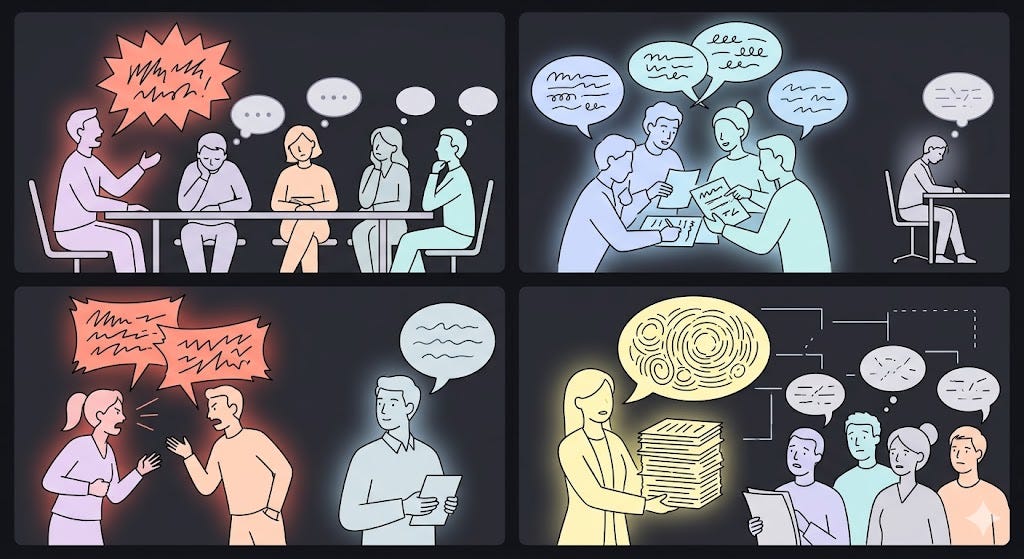
Previously, we looked at how leadership is not a personality type but a function that emerges within a group. Now, we will extend that to bystanding, enabling and bullying dynamics in groups, teams and communities. Because:
If groups generate leadership relationally,
they may also generate harm relationally.
📌
Harmfull and disruptive behaviors, passive and active forms of aggression, mobbying, bullying, these are not simply generated and sustained by the individual.
These are generated and sustained by the group dynamics around those individuals, and a “policy of silence” that often normalizes actively or passively harmful behavior.
Groups do not generate enabling (or any, really) behavior in a vacuum.
👉 They generate it within frameworks, processes, institutions and systems: workplace cultures, social norms, institutional processes.
🤫 Ones that make silence feel not just safe, but rational. Reasonable. Even virtuous.
This impulsive question of mine, reflexted in this article, asks:
🚨 What are the group/environmental/contextual/relational/organizational conditions that “enable the enablers” in the first place, or, more precisely, make it easy for disruptive behavior to emerge?
If silent bystanders often know that something is wrong, and
Bystander intervention can — positively or negatively — influence group norms,
then why does silence often remain a dominant response?
Environments That Make Harm Possible
Several conversations about bullying focus on individuals causing harm. Some extend to the bystander.
Fewer ask the more perhaps uncomfortable question:
👉 how does the group/community/organization itself contribute?
But studies spanning across decades of workplace psychology point consistently in a direction. Bullying is not simply, or primarily, a personality problem. It is an organizational one.
Workplace psychologist Denise Sali, as an example, identified three structural conditions1 that, when present together, make bullying not just possible but more likely:
🚨 power imbalances that give aggressors room to operate,
🚨 low perceived cost for harmful behavior (meaning the organization does not visibly respond), and
🚨 motivating structures (internal competition, scarcity of recognition, rewards tied to dominance rather than collaboration).
When, in an environment, these three conditions are present, bullying can emerge not despite the system, but through it.
A longitudinal study by Ågotnes and colleagues (2018) found that co-worker conflicts predicted new cases of bullying two years later, and that laissez-faire leadership, the kind that simply does not respond, significantly amplified this.
👉 Absence of leadership is not neutral. It reflects in a structural yet often unintentional and overlooked “green light”.
For many neurodivergent people in these environments, these conditions can compound. An organization designed around a single neurotype (one preferred communication style, one definition of “professionalism,” one reading of what composure looks like) is not a neutral environment for anyone who does not fit that type.
👉 It is an environment that generates friction, contextual assumptions, misreading, and vulnerabilities, often before any individual aggressor has acted at all.
A human environment does not necessarily need to intend harm to allow or sustain it.
Impartiality
When harm does occur, one of the most reliable features of the response is an appeal to balance.
“We need to hear both sides”
“Let’s not take sides”
“This is a complex situation”
These phrases feel reasonable. They carry the tone of fairness. And in genuinely symmetrical conflicts, they may be.
👉 But bullying is not a symmetrical conflict.
It is a pattern of sustained harm enabled by a power imbalances. Treating it as two equal perspectives obscures rather than clarifies.
Psychologists Morrison and Milliken described what they called organizational silence: a collectively maintained norm in which speaking up is perceived as unwise, costly, or futile — not because people are cowardly, but because the system has made the cost of voice consistently higher than the cost of silence.
👉 Silence can become rational. Relational context, even.
But silence is invisible: it feels more like the “absence of a problem” rather than the “suppression of information about one”.
This connects to Bandura’s concept of moral disengagement. This concept refers to the psychological mechanisms through which people who would not describe themselves as complicit manage to participate in harm.
One of the most common mechanisms is diffusion of responsibility: when everyone assumes someone else will act, no one does.
Another is euphemistic labeling: “high standards, direct feedback, this is just how he is” etc. Language that re-writes or re-frames harm, dismissing it as something else entirely.
👉 The appeal to impartiality performs this same function at the institutional level.
It allows an organization to appear responsive while leaving the underlying conditions unchanged.
📌
It portrays the person experiencing harm as one voice among several equally weighted ones places the burden of proof on the person who is already least protected.
For neurodivergent individuals, this burden lands with particular weight. As an example, many (but not only, nor exclusively) autistic and ADHD adults have learned:
to always anticipate exhaustive skepticism
to over-qualify their accounts of their own experience
to present their distress in a register that seems composed enough to be credible
often across years of struggling to be believed. The irony is that this very composure is then read as evidence that things are not that bad.
📌
Impartiality, when applied to asymmetric situations, is not a neutral position. It is a structural choice that tends to reproduce the pre-existing power arrangement.
For more details on inclusion of neurocognitive asymetries in real human teams:

Who Gets to Name Harm
The philosopher Miranda Fricker introduced the concept of testimonial injustice: the credibility deficit assigned to a speaker not because of what they say, but because of who they are. When this happens systemically (when a whole category of people finds their accounts routinely doubted, reframed, or dismissed) it is not a series of individual misunderstandings. It is a structural feature of how knowledge is organized within a group or institution.
👉 What happens when someone names harm in a context like this?
Sara Ahmed’s research on institutional complaints found a consistent pattern across organizations: the act of making a formal complaint generates its own problems for the complainant. They become identified with the complaint. They are seen as the source of disruption rather than the person responding to it.
📌
The institution, in protecting itself, absorbs the complaint by policy (procedures are followed, statements are taken, meetings are held) but the underlying behavior continues, and the complainant is progressively isolated.
“To be heard as complaining”, Ahmed notes, “is not to be heard”.
For neurodivergent people, these dynamics are further complicated by masking: the sustained effort to present as neurotypical in order to function in environments that were not designed for them. The term “masking” in this context is not about deception. It is a survival strategy. But it produces a gap between internal experience and external presentation that is regularly used against people when they name harm.
Research by Beck and colleagues captured this in a phrase that has stayed in the literature: “looking good but feeling bad.” A person who has masked successfully appears fine. They function. They meet expectations. And when they report that they are not fine, the visible evidence (their apparent composure) is invoked as a reason to doubt them.
The very capacity that allowed them to survive the environment is turned into evidence that the environment was not that harmful.
Sasson and colleagues found that non-autistic adults formed significantly less favorable impressions of autistic people within seconds, but that these impressions disappeared when the interaction was based on conversational content alone (written transcripts) rather than presentation style. Style, not substance, drives the credibility gap.
📌
This is not an individual prejudice. It is a patterned, potentially systemic one, and it shapes who gets believed when harm is named.
Empathy Gap as a Structural Condition
Damian Milton’s Double Empathy Problem (2012) offers a framework that challenges how we understand communication differences in majority-norm contexts.
The standard account of autistic social difficulty locates the problem solely in the autistic person: impaired theory of mind, difficulty reading others, atypical communication. Milton’s framework challenges this. The difficulty is mutual.
👉 Non-autistic people are also often inaccurate at reading autistic communication, emotional states, and intent. The gap runs in both directions.
Research by Crompton and colleagues made this more concrete: information transfer in autistic-to-autistic interaction was as effective as non-autistic-to-non-autistic interaction. The loss of information happened in cross-neurotype exchanges — and happened in both directions.
👉 Again, the problem is not simply a deficit in one party. It is a mismatch between two differently organized systems of communication.
What makes this a structural issue rather than an interpersonal one is the asymmetry of consequence.
Non-autistic people in majority-norm environments do not typically experience the gap as their problem. They experience autistic communication as difficult, odd, too literal, too intense, or insufficiently reciprocal. This reading shapes their social impressions, their trust judgments, and ultimately their credibility assessments.
Autistic people, by contrast, experience the consequences of being perpetually misread: exclusion, disbelief, constant social pressure to comply and mask, the exhaustion of endless adaptation, and more.
Chapman and Carel showed that this can extend to credibility: disclosure of an autism diagnosis in institutional settings tends to produce a reduction in how seriously a person’s accounts are taken. The diagnosis that might explain the pattern of harm they have experienced can become, simultaneously, the reason their account of that harm is doubted.
I don’t think this is incidental.
👉 This looks very much like the double empathy gap operating, in the background of everyday interactions, as a functional condition. Not just a conversational one.
And it means that neurodivergent, or otherwise vulnerable, people who name harm are often navigating not only the standard “credibility contest”, but an additional layer of misreading that has been reinfroced by the environment itself.
Structural Accountability
One hopeful finding of mine in relevant literature on the Bystander Effect is how little it can take to shift a dynamic.
🛟 One person who names what they are observing.
🛟 One person who does not laugh to another’s insult.
🛟 One person who checks in privately afterward.
These small acts can affect the perceived norm and change how others position themselves. In other words, they can impact and shift power imbalance.
But individual acts cannot reliably shift structures alone.
Ng, Niven, and Hoel found that bystander passivity compounds over time. The longer a group maintains silence around harm, the more normalized that silence becomes, and the harder it is for any individual to break it.
Early intervention matters. But so does the organizational climate that determines whether early intervention is possible in the first place.
Salmivalli’s research on participant roles in bullying found that these roles are not fixed. The same person can occupy different positions depending on context (on who else is present, on what the perceived norms are, on what costs and protections the environment provides). This is important because it means structural change is not utopian. It is possible.
📌
People are not so much “predetermined to enable” as “allowed to enable” by conditions that can be intervened with and redesigned.
What does that redesign require?
☝️Not more awareness campaigns, which address individual psychology while leaving organizational conditions intact.
☝️Not more mediation processes that place two parties in a room as though power were symmetrical.
☝️Not more complaint procedures that absorb harm without addressing its sources.
It requires:
Taking seriously the organizational conditions that produce or allow bullying behaviors to emerge (the enabling structures Salin identified) and changing them.
Recognizing that impartiality in asymmetric situations is not fairness.
Building into formal processes some accounting for the credibility gap that systematically disadvantages those with less institutional power.
Accounting for the conditions that make neurodivergent and vulnerable individuals disproportionately exposed.
Not because they are fragile, but because environments designed for one neurotype generate misreading, misattribution, and disbelief as structural outputs: before any individual aggressor acts, and long after one has.
📌
Inclusive design, in this sense, is not accommodation. It is the removal of the preconditions for certain kinds of harm.
A Closing Reflection
This conversation began with a question about leadership: not who holds it, but how it emerges from the group dynamics.
Here, we extended that to bullying: not who causes it, but how groups allow and sustain it. And pushed with a further question: not just what the group does, but what the system surrounding the group was built to protect. Every organization generates a set of answers to that question (often without ever asking it explicitly).
Those answers are visible:
👉 In who gets supported and who gets “managed out”.
👉 In how complaints are received.
👉 In what counts as evidence of harm.
👉 In whose communication style is legible and whose is read as difficult.
👉 In who, when they finally speak, is heard.
The question is no longer: “Am I neutral?”. It is: “What or whom does this stance protect, and who’s vulnerablity does it expose?”.
An organization that has not asked that question has possibly already answered it.
👉 Wanna look into it further?
Ågotnes, K. W., Einarsen, S. V., Hetland, J., & Skogstad, A. (2018). The moderating effect of laissez-faire leadership on the relationship between co-worker conflicts and new cases of workplace bullying. Human Resource Management Journal.
Ahmed, S. (2021). Complaint! Duke University Press.
Bandura, A. (1999). Moral disengagement in the perpetration of inhumanities. Personality and Social Psychology Review.
Beck, J. S., Lundwall, R. A., Gabrielsen, T., Cox, J. C., & South, M. (2020). Looking good but feeling bad: “Camouflaging” behaviors and mental health in women with autistic traits. Autism.
Chapman, R. & Carel, H. (2022). Neurodiversity, epistemic injustice, and the good human life. Journal of Social Philosophy.
Crompton, C. J., Ropar, D., Evans-Williams, C. V. M., Flynn, E. G., & Fletcher-Watson, S. (2020). Autistic peer-to-peer information transfer is highly effective. Autism.
Fricker, M. (2007). Epistemic Injustice: Power and the Ethics of Knowing. Oxford University Press.
Harsey, S. & Freyd, J. J. (2020). Deny, Attack, and Reverse Victim and Offender (DARVO): What is the influence on perceived perpetrator and victim credibility? Journal of Aggression, Maltreatment & Trauma.
Milton, D. E. M. (2012). On the ontological status of autism: the ‘double empathy problem.’ Disability & Society.
Morrison, E. W. & Milliken, F. J. (2000). Organizational silence: A barrier to change and development in a pluralistic world. Academy of Management Review.
Ng, K., Niven, K., & Hoel, H. (2020). ‘I could help, but…’: A dynamic sensemaking model of workplace bullying bystanders. Human Relations.
Salin, D. (2003). Ways of explaining workplace bullying: A review of enabling, motivating and precipitating structures and processes in the work environment. Human Relations.
Salmivalli, C., Lagerspetz, K., Björkqvist, K., Österman, K., & Kaukiainen, A. (1996). Bullying as a group process: Participant roles and their relations to social status within the group. Aggressive Behavior.
Sasson, N. J., Faso, D. J., Nugent, J., Lovell, S., Kennedy, D. P., & Grossman, R. B. (2017). Neurotypical peers are less willing to interact with those with autism based on thin slice judgments. Scientific Reports.
This framework, however, leaves out some perceived as “uncommon”, yet, existing mental health disturbances reflecting in individual behavior that demonstrates persistent, severe tendencies for moral, physical, legal system exploitations and violations.